AI Must Earn Its Place on the American Acre
EA Take
Founder & CEO Shawn Cutter makes the case for a new bargain: AI infrastructure that pays its own way, discloses its water use, reuses its heat, and leaves the town it lands in stronger. It is the clearest statement yet of the EnergiAcres thesis.
America has solved a version of the artificial-intelligence infrastructure problem before.
In 1930, nearly nine in 10 urban and nonfarm rural homes had electricity. Only about one in 10 farms did. Private utilities saw long lines, thin demand, and bad economics.
Rural electrification worked because the country did more than subsidize wire. Federal credit supported local cooperatives. Engineers standardized construction and cut line costs. Farmers financed the wiring and equipment that made the new service productive immediately — electricity ran milk coolers, pumps, refrigeration, and workshops. The line became financeable because the farm became more productive.
AI presents that last-mile problem in reverse. Instead of taking electricity out to the American acre, we are bringing city-scale computing loads onto it. The cloud has an address, a cooling system, a water budget, a utility bill, and neighbors.
The national need is real. The Energy Department says data centers consumed about 4.4% of U.S. electricity in 2023 and could consume 6.7% to 12% by 2028. The International Energy Agency expects global data-center electricity demand to more than double by 2030, and estimates that grid constraints could delay roughly one-fifth of planned projects. AI may be digital, but its bottleneck is physical.
The political bottleneck is just as real. A June Reuters/Ipsos poll found that only one-third of Americans support rapid construction of AI data centers. Fifty-seven percent oppose having one in their community, and 77% worry AI will make electricity more expensive. Ohio regulators have required large data-center customers in an American Electric Power territory to pay for at least 85% of projected usage. The state has also paused new data-center tax incentives after the program's cost vastly exceeded earlier projections.
The industry can dismiss this as NIMBYism. That would be an expensive mistake. Communities see a one-sided offer: provide land, power, water, tax concessions, and political permission — while the product, compute, leaves the site. The permanent payroll can be modest relative to the capital invested and the infrastructure capacity reserved. Residents are asking who gets the upside and who carries the risk.
America should not stop the AI buildout. It should modernize the bargain — in five ways.
First, the load should pay its own way. Every project should bring a credible plan for incremental capacity: dedicated generation, storage, firm supply contracts, grid upgrades, flexible operations. Households and existing businesses should not finance speculative facilities or stranded infrastructure. Ratepayer protection requires contracts, credit support, and minimum-demand commitments — not a press release.
Second, publish a water budget before seeking approval. Cooling systems vary widely, and not every data center is a large water consumer — which makes site-specific disclosure more important, not less. The public should see the source, the peak and annual demand, the cooling method, the reuse plan, the discharge, and the drought response.
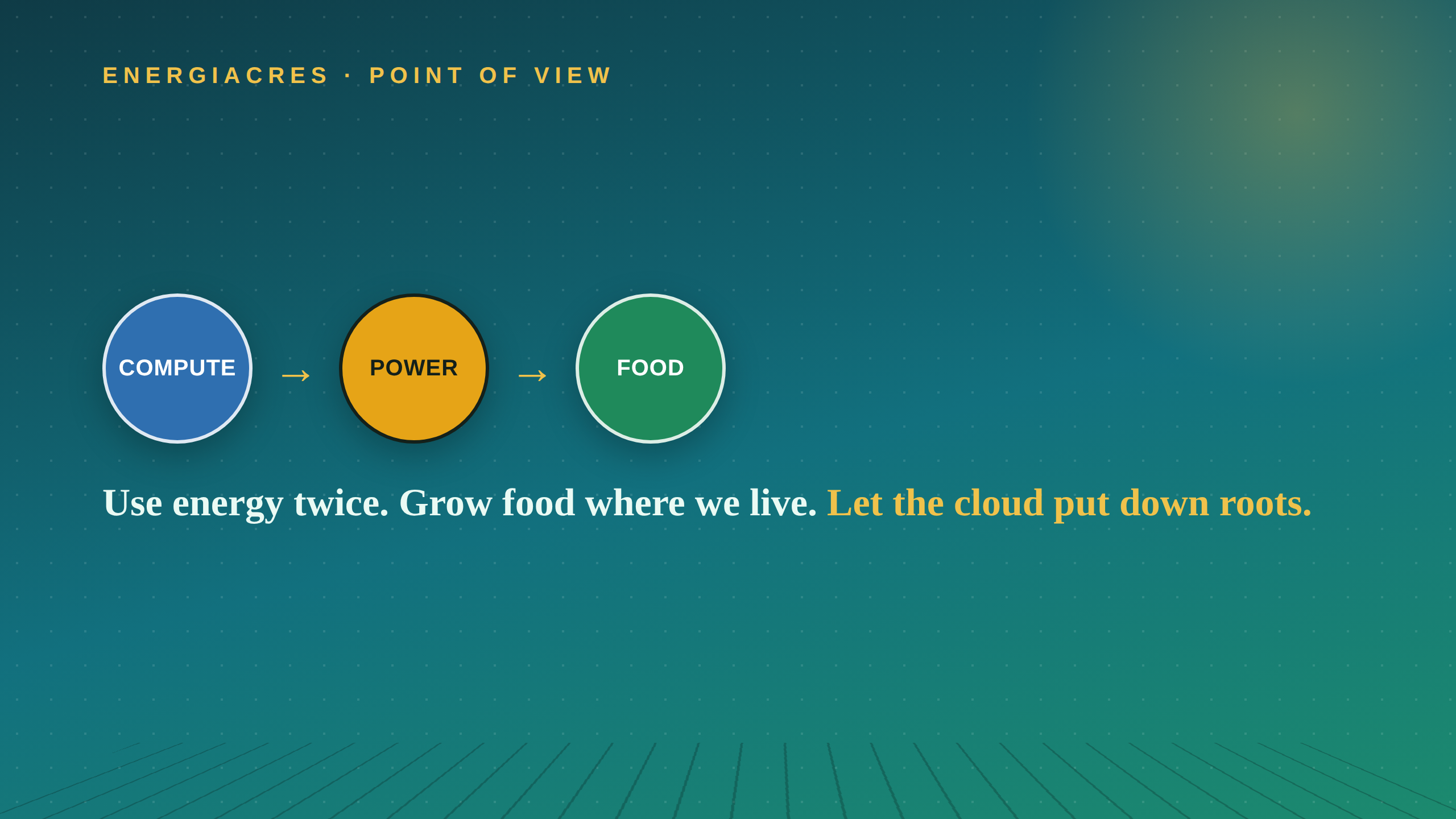
Third, use energy twice. Servers convert nearly all the electricity they consume into heat, and on-site generation can provide higher-temperature thermal energy as well. Not all of that heat is economical to recover — temperature, distance, seasonality, pumping, and backup all matter. But when the second customer is designed into the campus, useful heat can support industrial processes, district energy, water treatment, or controlled-environment agriculture. Heat reuse should begin as a contract, not a sustainability slide. Otherwise the “circular” campus is only a rendering.
Fourth, grow food where we live. The Agriculture Department says imports supplied 59% of U.S. fresh-fruit availability and 35% of fresh vegetables in 2023. Greenhouses won't replace field agriculture or trade — but they can produce selected perishable crops near consumers, create year-round work, and buy heat that a power plant or data center would otherwise reject. The food operation must be real: an experienced grower, credible crop economics, customer offtake, a water plan, and a stand-alone P&L. Tomatoes drawn beside a server hall do not make a project circular.
Fifth, make the local bargain enforceable. Developers should sign host-community compacts covering incremental power, ratepayer protection, water, useful heat, workforce targets, local procurement, public reporting, and a mechanism for sharing long-term value. A community benefit trust, local food cooperative, thermal utility, or minority investment vehicle can give residents a stake.
None of this is philanthropy. Public opposition can delay a permit, change an election, kill a tax incentive, and raise carrying costs. A site with power but no durable permission is stranded optionality. Community alignment belongs in underwriting.
Rural electrification did not ask farmers to admire the power line. It gave them tools to produce more. AI developers should not ask towns to admire server halls. The old American bargain took power to the acre and made the acre more productive. The new bargain should bring compute to the acre and make the town around it more productive too. Use energy twice. Grow food where we live. Let the cloud put down roots.