Build It in Circles
EA Take
A manifesto in Shawn Cutter's own voice. The AI age is making a “shape” decision right now — boxes or circles — and the circle isn't the virtuous choice that costs you; it's the intelligent one that pays. The worldview beneath everything EnergiAcres builds.
The story goes like this. Artificial intelligence is the most important technology of our lifetimes, and it runs on an appetite for electricity that has no precedent in industrial history. To feed it, we will build data centers — thousands of them, each one a windowless box the size of a town, drawing power like a small city and water like a small river. These boxes will land wherever the grid and the tax incentives allow. Communities will fight them. Some will lose, and get a box. Some will win, and watch the box go to the next county over. Ratepayers will absorb the cost of the new transmission lines. Aquifers will absorb the cost of the cooling. And the rest of us will absorb a new ambient anxiety: that the machines are coming for the power, the water, and the quiet, and there is nothing to be done but negotiate the terms of the taking.
That is the story. You have read it in every newspaper. You have heard it in every township meeting. It is a story about extraction, and it casts every one of us in a familiar and exhausting role: the AI companies extract, the utilities enable, the communities resist, and the planet pays.
The story is not wrong about the facts. The power demand is real. The water is real. The strain on the grid is real. The community anger is real and earned. But the story is wrong about something more important than the facts. It is wrong about the shape.
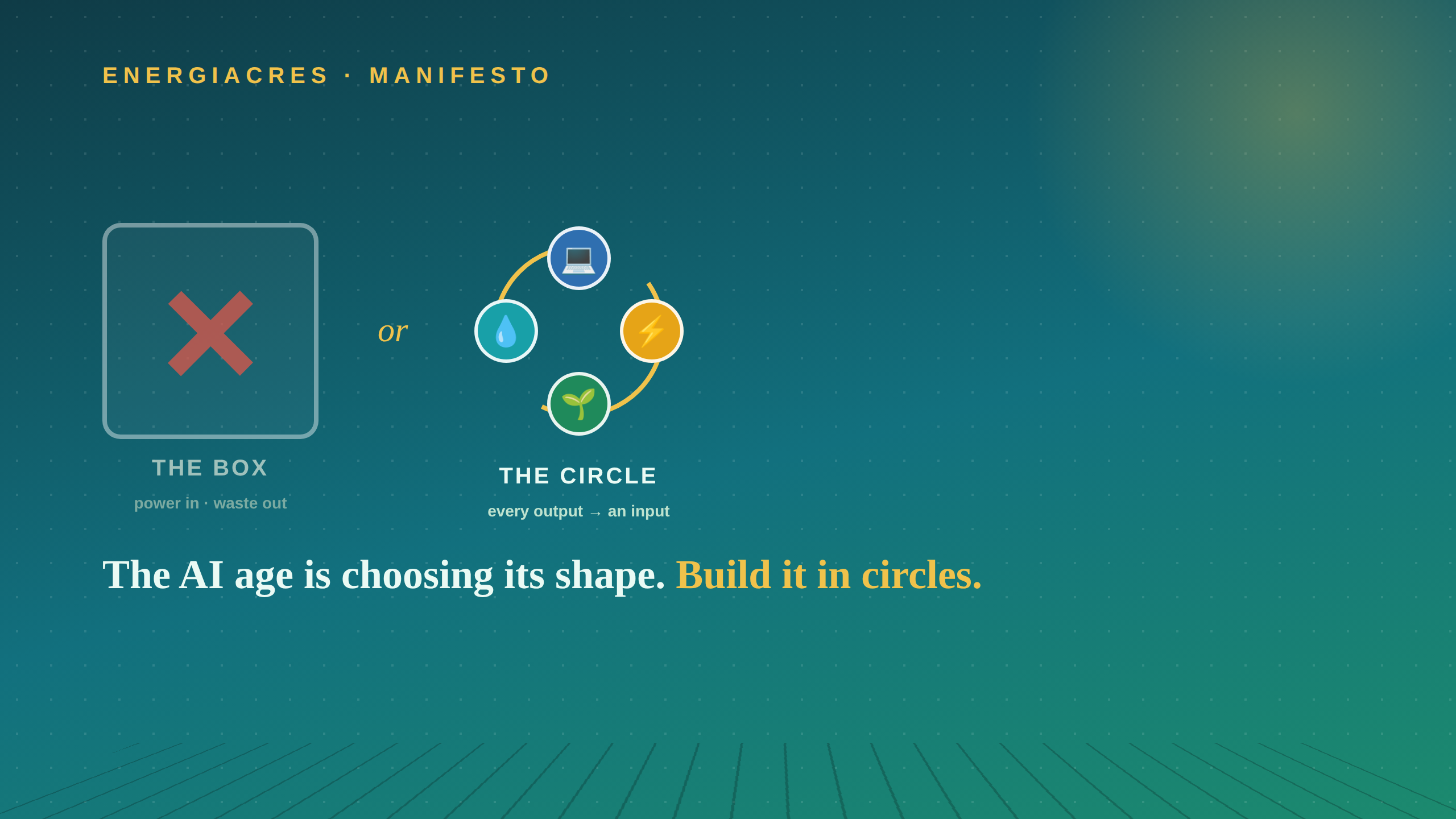
Every story about data centers is a story about a box — a discrete object, with inputs flowing in and waste flowing out. Power in, heat out. Water in, warm water out. Money in, compute out. The box takes what it needs and discards what it doesn't, and the entire public conversation is just an argument about the size of the box, the price of its inputs, and where its outputs are allowed to go. The box is a failure of imagination before it is a failure of engineering.
Here is what a box does: it treats every output as a problem to be disposed of. The heat is a problem — vent it. The CO₂ is a problem — emit it. The water is a problem — discharge it. The reserved-but-unused power capacity is a problem — strand it. The community's attention is a problem — manage it. A box is a machine for converting valuable things into waste as efficiently as possible, and then asking the surrounding world to absorb the waste.
We have built industrial civilization out of boxes for two hundred years, and we are very good at it. The shale fields I spent my career instrumenting were boxes too, in the beginning — extract the hydrocarbon, flare the gas you can't sell, truck away the produced water, move on. It took the industry decades and a near-death experience with its own communities to learn that the waste streams were not waste. The flared gas was electricity. The produced water was a resource to be managed in a loop. The relationship with the landowner was not an externality; it was the license to operate.
The AI infrastructure industry is about to learn the same lesson. It can learn it the slow way, box by box, town by town, lawsuit by lawsuit, over twenty years. Or it can start from a different shape. The different shape is a circle.
A circle does not have waste. A circle has flows, and every flow that leaves one part of the system is an input to another part.
Take the same data center. In a box, its heat is a disposal problem. In a circle, that heat is the thermal energy that lets you grow food twelve months a year in a climate that otherwise couldn't. In a box, the captured CO₂ is an emissions liability. In a circle, it is the gas you pump into a greenhouse to make tomatoes and leafy greens grow faster. In a box, the power plant you built for reliability sits idle most of the time, a stranded asset. In a circle, the redundant capacity firms the local grid and lowers costs for the neighbors. In a box, the community is a constituency to be managed. In a circle, the community is the reason the thing exists at all — because the food, the jobs, the energy resilience, and the tax base are not byproducts of the compute. They are the point of the compute.
This is not a metaphor. It is a design specification. When you put power generation, AI compute, and controlled-environment agriculture on the same campus and connect their flows on purpose, the exhaust of the digital economy becomes the input to the food economy. The thing the box throws away is the thing the circle is built around.
I have spent enough time in front of skeptical township boards to know how this sounds the first time. It sounds too good. It sounds like a developer's fairy tale. So let me be precise about what I am and am not claiming. I am not claiming a circle is free — it costs more to design and more to build than a box, because integration is harder than disposal. I am not claiming every flow closes perfectly; thermodynamics takes its cut, and some waste is real waste. And I am not claiming this is charity. It is the opposite of charity.
A circle is a better business than a box, because it converts the things a box pays to dispose of into things a circle sells — food, firmed power, captured carbon, and community goodwill that shortens permitting and lowers the political risk premium that every serious investor is now quietly pricing into every box. The circle is not the virtuous choice that costs you. The circle is the intelligent choice that pays you. That is why I believe it wins — not because people will choose virtue over money, but because eventually they will notice that the circle is the money.
There is a narrow window here, and I want to name it plainly, because windows close. AI compute is being sited right now. The next five years will lay down the physical infrastructure of the AI age — where the campuses go, how they are powered, what they do with their waste, what they owe the places that host them. Concrete is being poured against the box model as you read this. And concrete is a decision that lasts forty years.
This is the same kind of moment the energy industry faced a century ago when it decided that power plants would be enormous, central, and far away — a decision whose consequences we are still living inside. It is the moment the agricultural industry faced when it decided food would be grown in a few distant places and shipped thousands of miles to everyone else — a decision that gave us abundance and fragility in equal measure. These were shape decisions, made early, that locked in everything that followed.
The AI age is making its shape decision now. Boxes or circles. Extraction or integration. Waste or flow. And the default — the path of least resistance, the thing that happens if no one insists otherwise — is boxes. Boxes are easier. Boxes are what the existing playbook builds. Circles do not happen by default. They have to be insisted upon, by people who can see the whole system and have the stubbornness to build it integrated when building it separate would be easier. That insistence is what EnergiAcres exists to provide.
If you run an AI company or a hyperscale operator: the box is a liability you have not finished paying for. Every town that fights you, every aquifer that runs low, every ratepayer revolt, every stranded-asset write-down is the box presenting its true cost. The circle is not a CSR program. It is a risk-reduction strategy and a margin strategy wearing the same coat.
If you allocate capital: stop underwriting these campuses as real estate with a power contract. They are industrial assets with forty-year lives whose value is determined by how well their flows are integrated. A box depreciates. A circle compounds. The market has not repriced this distinction yet. That gap is the opportunity.
If you make policy or regulate: the unit you are regulating is not the building. It is the system of flows — power, heat, water, carbon, load, and community benefit. The jurisdictions that write their rules around the circle will get better outcomes for their ratepayers, their communities, and their land than the ones that keep permitting boxes and litigating the consequences. The first state to get this right sets the standard the others copy.
And if you are simply someone who lives near where one of these things might be built: you have been cast in the role of resister, and it is an exhausting role, and you did not choose it. That role is a function of the shape. You resist a box because a box offers you nothing but its externalities. You would not resist a thing that grew your food, employed your kids, firmed your grid, lowered your costs, and told you the truth about what it was doing on your land. You would not resist a circle. You would ask why it took so long to arrive.
So let me say what the world looks like if we get the shape right, because we spend too much time describing the problem and not enough describing the thing worth building. Picture the campus. Not a windowless box behind a berm and a chain-link fence, but a working landscape. The power generation and the compute are there, humming, doing the heavy work of the digital economy. But wrapped around them, fed by their flows, are greenhouses producing fresh food year-round in a place that used to import all of it in winter. The heat that a box would have vented into the sky is growing leafy greens. The CO₂ that a box would have emitted is feeding tomatoes. The power capacity held in reserve for reliability is, in its idle hours, firming the grid for the town next door and lowering everyone's bill. The local high school runs a workforce program on-site. The county's tax base is broader than it has been in a generation. And on a public dashboard that anyone can pull up, the numbers are right there — kilowatt-hours generated, pounds of food delivered, tons of carbon captured, food-miles erased, the water that went in and the water that came back.
The compute trains the models that change the world. And the same campus, with the same molecules, feeds the people who live beside it. That is not two businesses pretending to be friends. That is one system, built in the shape of a circle, doing what a circle does.
We can build the AI age out of boxes and spend the next two decades fighting about the wreckage. Or we can build it in circles and discover that the largest energy build-out in human history was also the thing that re-localized the food supply, hardened the grid, and gave a thousand communities a reason to say yes. I know which one I am building. The only real question is how many of us decide to build it in circles before the concrete sets.
Power for AI. Food for everyone. Build it in circles.