The Acre and the Algorithm
EA Take
Founder & CEO Shawn Cutter on why AI's hardest problem is physical, not digital — and how a farmer's systems thinking points to “productive infrastructure” that leaves the place stronger.
I come from six generations of Ohio farmers. Farming teaches systems thinking before anyone gives it that name.
A farm is not a set of independent assets. Soil, water, weather, energy, equipment, labor, markets and time all interact. A decision that looks efficient in one part of the system can create a loss somewhere else. A useful input is rarely asked to produce only one benefit. Manure becomes fertilizer. Crop residue protects soil. A barn stores equipment, shelters livestock and creates a place to work through winter. The discipline is not to romanticize waste. It is to notice value before throwing it away.
That way of thinking is missing from much of America's artificial-intelligence buildout.
AI may be the most sophisticated technology ever commercialized at scale, but its infrastructure problem is elemental. It needs land. It needs electricity. It needs firm capacity, transformers, switchgear, fuel, cooling, water, fiber, roads, permits and communities willing to host facilities that can consume as much power as a city.
The industry calls these facilities “the cloud.” The phrase is misleading. The cloud is not in the sky. It has an address, a utility bill and neighbors.
For the past several years, the market acted as if computing capacity could be ordered like software. Secure a site. Submit an interconnection request. Announce billions of dollars. Negotiate incentives. Add a row of trees and a community-benefits page. Then wait for the physical world to cooperate. The physical world has stopped cooperating.
The U.S. Department of Energy reported that data centers consumed about 4.4 percent of American electricity in 2023 and could consume 6.7 to 12 percent by 2028. The International Energy Agency expects global data-center electricity demand to more than double by 2030 and estimates that grid constraints could delay about one-fifth of planned projects unless they are addressed. Transformers, turbines, cables and transmission are no longer background items. They are critical-path assets.
Public consent has become critical path too. A June 2026 Reuters/Ipsos poll found that only one-third of Americans supported rapid construction of AI data centers, 57 percent opposed having one in their own community and 77 percent worried that AI development could raise electricity costs. Legislatures across the country are considering moratoriums or tighter restrictions. Ohio has imposed stronger large-load cost protections and paused a data-center tax incentive after its fiscal cost grew far beyond earlier expectations.
The revolt is not irrational. It is a response to an offer that often looks one-sided. A conventional data center arrives with a large appetite for power and land, and the compute it produces serves customers somewhere else. The most visible local effects are the construction site, the substation, the power lines, the generators, the water questions and the tax negotiation. The permanent payroll is often modest compared with the capital invested. Residents are asked to trust forecasts they did not build and agreements they cannot see.
The industry's instinct is to call this NIMBYism and improve the public-relations campaign. That misses the market signal. Communities are not simply rejecting technology. They are rejecting a weak bargain.
EnergiAcres was built around a different bargain. Our premise is that the AI campus should be designed as a local production system, not a single-use industrial box. Compute is one output. Useful heat, local food, skilled work, infrastructure capacity and community resilience can be others. The task is to make those outputs physical, contractual and financeable.
We call the governing idea productive infrastructure. It does not merely consume capacity; it increases the capacity of the place around it. It asks what else the same land, energy, water, pipes, roads and workforce can produce. It makes the host community a design participant rather than an obstacle to be managed.
The first rule is simple: use energy twice. That phrase is not a claim that physics gives us two units of energy for the price of one. It is a refusal to discard useful thermal value. When fuel is converted to electricity, a large share of its energy ordinarily leaves as heat. Combined heat and power systems recover part of that heat for a useful second purpose — the Department of Energy says well-designed CHP can operate at roughly 65 to 75 percent overall efficiency, compared with about 50 percent when electricity and thermal services are provided separately.
Computing itself also converts nearly all the electricity it uses into heat. That heat is often lower-temperature and harder to use; its value depends on cooling architecture, temperature, distance, timing, pumping and the needs of a nearby customer. Liquid-cooled AI systems can produce a more concentrated thermal stream, but there is no universal solution. The honest design rule is this: recover the highest-value heat first, locate the user close to the source, and do not count a thermal benefit until an operator is willing to contract for it.
On an EnergiAcres campus, electricity serves the compute load first. Recoverable heat from on-site generation, and server heat where the engineering works, is then matched to a second load. In one place that may be a greenhouse. In another it may be district heating, an industrial process, aquaculture, biomass drying or water treatment. The second use is determined by the site, not by a slogan.
The second rule is: grow food where we live. America will continue to trade food across borders; local production is not a substitute for field agriculture or international commerce. It is a resilience layer. USDA data show imports supplied 59 percent of U.S. fresh-fruit availability and 35 percent of fresh-vegetable availability in 2023 — abundance that also reveals how far perishable products travel and how exposed communities are to logistics, weather, border and fuel disruptions.
Controlled-environment agriculture can produce selected crops near demand, through winter, with tight control of water and nutrients. It can create visible, year-round work and a customer for heat that would otherwise be rejected. But it is not automatically economic. Lighting, climate control, crop choice, labor, financing and offtake decide whether a greenhouse is an asset or a burden. So EnergiAcres should never treat food as a decorative annex: the grower must be independent, experienced and accountable; the crops must have a market; and the heat and water savings must appear in a real operating model.
When those conditions are met, food changes the meaning of the campus. The data center still produces compute for the world, but the site also produces something residents can see, buy, work in and explain to their children. The campus becomes a place where digital infrastructure supports physical abundance, and the relationship between technology and town becomes less abstract.
That matters because permission is part of the asset. A developer can control land and still not control a site. A utility letter can show capacity and still not guarantee a schedule. A zoning designation can allow a use and still not create public legitimacy. A campus becomes real only when technical, commercial, regulatory and community permissions align.
This is where circularity becomes financial rather than cosmetic. A credible thermal customer improves the utilization of fuel and equipment. A transparent water plan removes a source of opposition. A local food operator creates permanent jobs and a visible constituency. A ratepayer-protection structure answers the most politically dangerous question of all — whether families and existing businesses will subsidize a new hyperscale load. None of these replaces power, tenancy or project finance. They improve the probability that those elements survive the development process.
Investors often separate “project economics” from “community benefits.” That distinction is becoming obsolete. In a market where local opposition can delay a permit, change an election, block a zoning action or destroy a tax incentive, community alignment affects schedule, carrying cost, financing certainty and residual land value. It belongs in underwriting.
This does not mean promising the town everything. It means promising only what can be engineered, financed and measured — then making those promises enforceable. EnergiAcres formalizes that discipline through a Host Community Compact: incremental power rather than reserved scarce capacity; transparent allocation of grid-upgrade costs; a public water budget; a thermal plan that names its source, temperature, customer, distance and utilization; local production run by a qualified partner; workforce and procurement targets with responsible parties; and a recurring public scorecard. A compact of that kind is not charity. It is infrastructure governance.
Rural America has solved infrastructure gaps through cooperative organization before. In 1930, nearly nine in ten urban and nonfarm rural homes had electricity, but only about one in ten farms did. Private utilities often considered the last mile uneconomic. Rural electrification succeeded because the country did more than subsidize wire: federal credit supported local cooperatives, engineers standardized construction and cut the cost of rural lines, and loans helped farmers wire buildings and buy the equipment that created productive demand from the beginning. The line became financeable because the farm became more productive.
AI presents the inverse last-mile problem. The twentieth-century challenge was to bring electricity out to farms. The twenty-first-century challenge is to bring enormous new computing loads into rural and industrial communities without letting those loads drain the places that host them. The old model took power to the acre and made the acre more productive. The new model should bring compute to the acre and again make the acre more productive.
That is the American story EnergiAcres can credibly tell. America has always been strongest when it turns constraints into systems. Sparse rural settlement produced the electric cooperative. Vast distances produced rail and highway networks. Agricultural risk produced extension services, crop science and new forms of finance. The country now faces a new constraint: the most advanced digital economy in the world depends on a physical infrastructure stack that is slow, local, capital-intensive and politically exposed. EnergiAcres is not trying to make that stack disappear. We are trying to organize it.
North Central Ohio is the first place to prove the model — a core industrial site with mapped expansion potential, access to a major gas corridor, utility backup, fiber pathways, and water and sewer planning. Those facts are promising. They are not yet the proof. The proof will be an evidence binder that shows current land control, gas service, power design, permitting basis, fiber diversity, water balance, anchor demand, food operator, thermal offtake, community compact and financing path — every claim linked to a source, every promise with an owner. That rigor is not a concession to skeptics. It is the product.
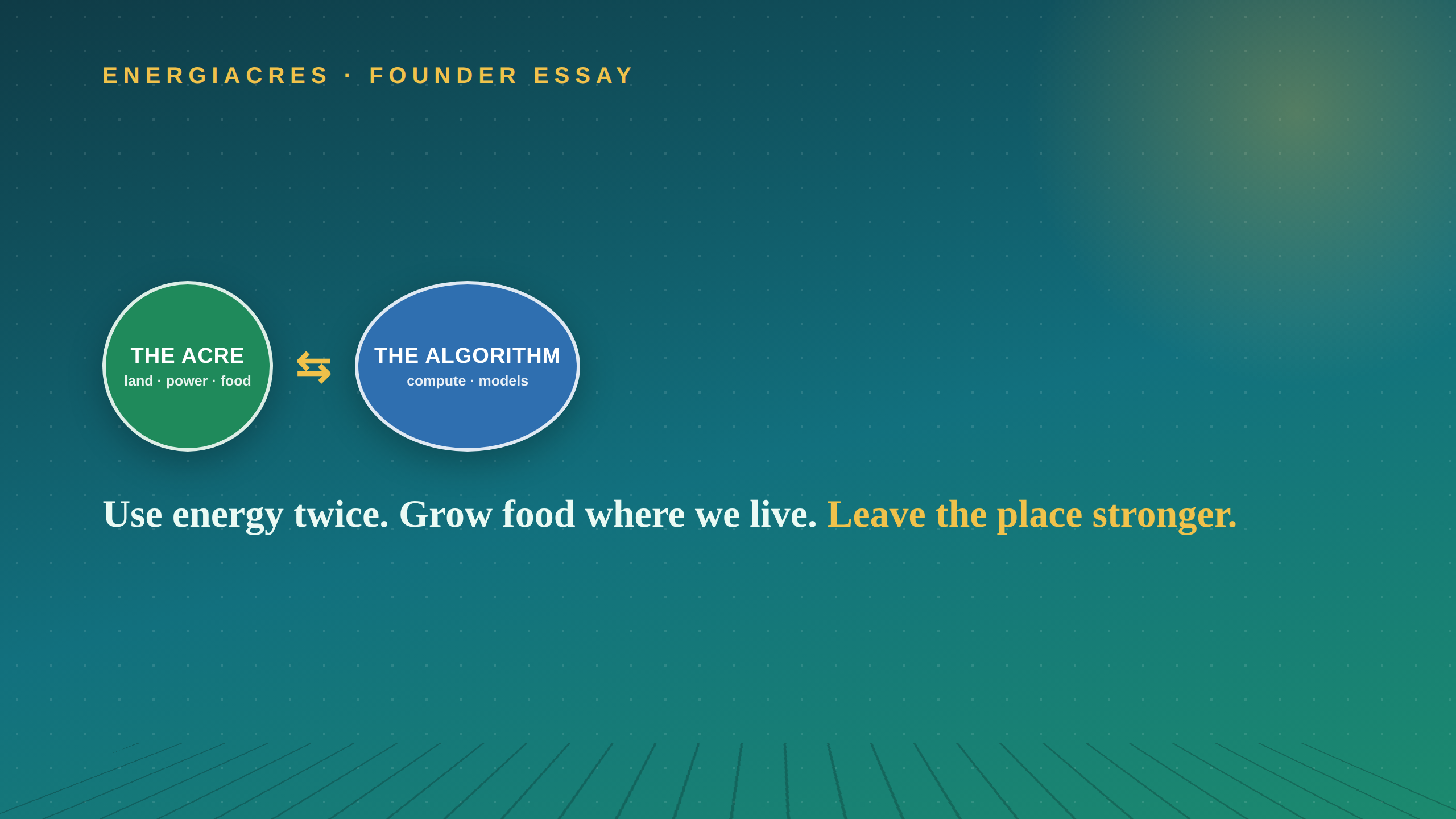
The phrase “use energy twice” captures the physics. “Grow food where we live” captures the local result. But the deeper principle is larger: build the future here, and leave the place stronger. That is not anti-technology — it is how technology earns the right to scale. It is not anti-growth — it is a demand for growth that compounds rather than extracts.
The algorithm may be global. The infrastructure will always be local. The next American infrastructure company will understand both.