The Cloud Is Physical. Its Next Operating System Will Be Too.
EA Take
EnergiAcres' category thesis in four moves — the cloud is physical, the data center is the wrong unit of design, industrial AI must organize reality, and AI cannot scale as an extraction industry. A conceptual framework; capabilities remain subject to diligence and deployment.
There is a comfortable story about artificial intelligence: that it lives in the cloud, that it scales like software, and that its only real limit is how clever the models become. The story is wrong in a specific and expensive way. AI's defining constraint will not be intelligence. It will be the coordination of everything that intelligence physically requires.
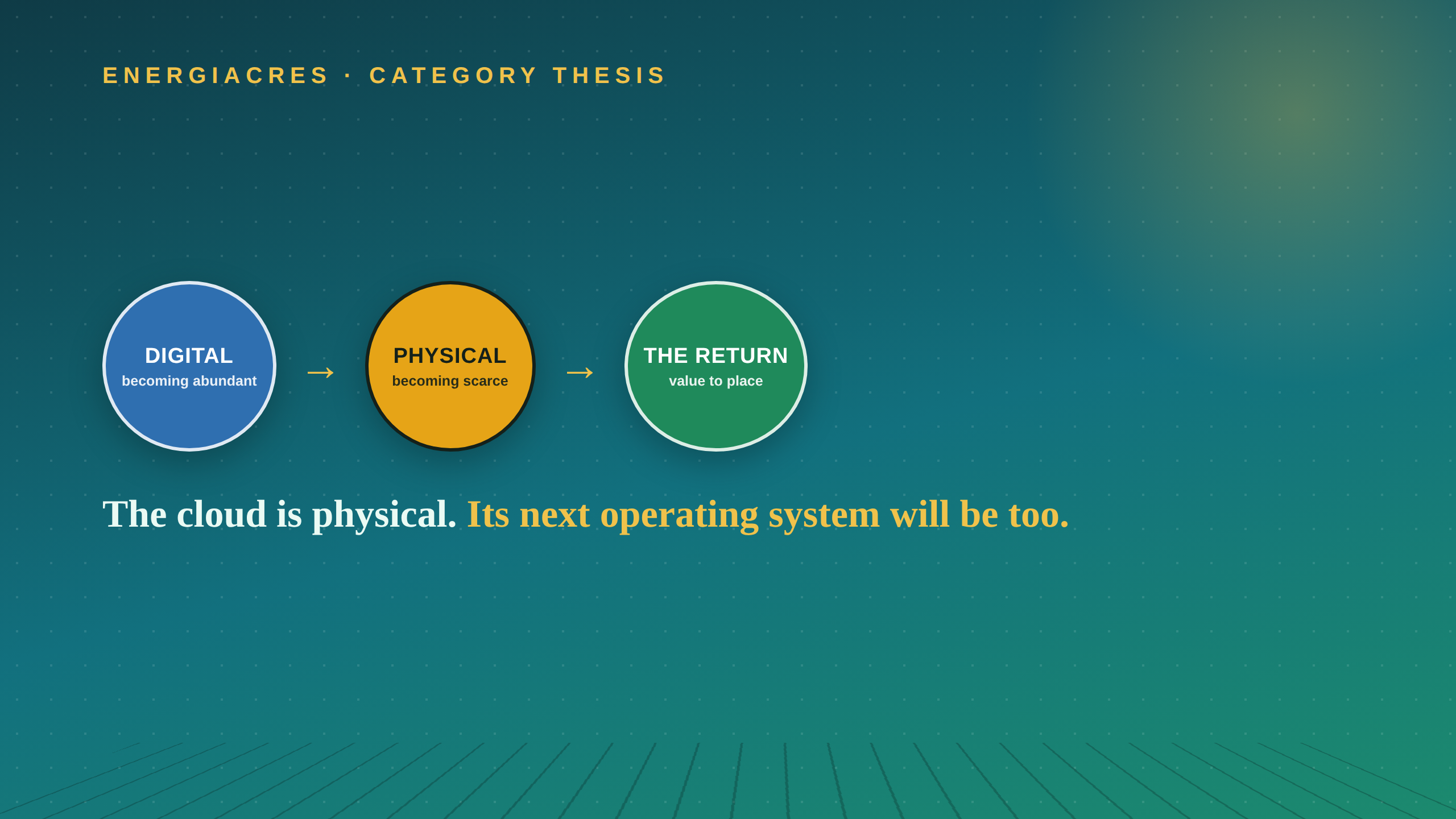
Digital intelligence is becoming abundant. Reasoning, code, prediction, optimization — the models improve rapidly and get cheaper by the month. Physical capacity is moving the other way. Land, power and fuel; fiber, water and cooling; permits, labor and public consent are becoming scarce, slow and contested. Value is migrating from the thing that is getting easier to the thing that is getting harder.
The AI industry optimizes what happens inside the server. EnergiAcres begins where that abstraction ends. We treat powered land, generation, compute, thermal flows, water, food production and community infrastructure as one coupled design problem — and build the development intelligence to make the evidence reusable from one project to the next. The cloud is physical. We are building the intelligence layer beneath it.
That starts by fixing the unit of design. Most infrastructure waste is not caused by inefficient equipment. It is caused by drawing the system boundary too narrowly. The data center, taken alone, is the wrong unit.
Design the isolated box and you optimize a building while externalizing the system: power goes in, compute comes out, heat is rejected, water is consumed, digital value leaves, and community benefit is negotiated after the design is already fixed. Design the integrated campus instead and you design the flows — firm power, AI compute, useful thermal energy, food and district heat — so that each asset is evaluated partly by what it makes possible for the others. The campus is not a data center with decorative agriculture attached.
Three rules make that real. First, use energy twice: treat otherwise-rejected thermal energy as a design input. Second, design offtake early: match temperature, distance, seasonality, contracts and capital before the site is fixed, not after. Third, embed the return: make local value physical, funded and measurable — not a public-relations appendix. Do not optimize the box. Redesign the system around it.
Coordinating that system is a different kind of software problem than the one Silicon Valley has already solved. Software organized information. Industrial AI will organize reality. Industrial development is not merely data-poor; it is coordination-poor.
A real campus has to reconcile land (control and permits), electrons (grid and power), molecules (gas and fuel), biology (food and water) and capital (engineering and finance) — usually held by different owners who underwrite different risks. The development intelligence has to do four things across all of them: see (unify documents, maps, studies and telemetry), prove (attach sources to every claim, assumption and dependency), decide (expose fatal flaws, scenarios, owners and critical path), and learn (turn each diligence cycle into reusable intelligence).
Software alone cannot secure land, contract energy or obtain permits. And a conventional developer rarely turns each project into a compounding intelligence asset. EnergiAcres is designed to do both. The next industrial operating system will not manage files. It will coordinate reality.
None of this matters if the industry keeps trying to scale as an extraction business. Community resistance is usually not a communications problem. It is a rational response to infrastructure that concentrates burdens locally and exports value elsewhere.
The old bargain offers a town local inputs and distant value: it supplies land, infrastructure capacity, power, water and construction burden — plus the risk, the noise and the public attention — in exchange for benefits that stay abstract or delayed. The EnergiAcres compact inverts it: industrial scale, and a measurable return to place. Productive thermal and water reuse where viable. Controlled-environment food production. Shared infrastructure and workforce pathways. Commitments designed before entitlement, not after.
That requires a company willing to cross the boundaries traditional firms defend — energy, compute, land, water, agriculture, technology, finance and place. Most firms pick one and externalize the rest. The missing institution holds them together, not by attaching philanthropy to development, but by redesigning development to endure.
Use energy twice. Grow food where we live. Make place stronger. The world does not need more data centers. It needs AI infrastructure that gives back.
The cloud is physical. Its next operating system will be too. Power for AI. Food for everyone.